
Last updated: May 08, 2012

Mice Study Reveals A Mystery of The Developing Brain
Mice Study Reveals A Mystery of The Developing Brain
April 2010
 |
A congenital defect called microcephaly causes small brain size and varying degrees of mental impairment in humans and animals alike. Researchers at the National Human Genome Research Institute, and others, recently identified a gene in mice that can cause this developmental brain disorder when inactivated. Other genetic problems also may cause microcephaly, but inactivation of this gene alone seems capable of producing under-developed brains.
The finding also provides clues about molecular mechanisms in cancer. The study was published in the April 4, 2010, early online edition of the journal Nature Neuroscience.
In the case of the brain, size matters. Unless the brain develops fully, a process launched during fetal development, cognitive activity will be abnormal. Brain size is controlled by regulating neural stem cell division, which requires the actions of many genes that convert the stem cells into different types of neurons in the brain. In the new study, the researchers were able to parse out a critical piece of the brain development puzzle focused on a single gene.
"This study demonstrates the power of using genetic screens in model organisms for transformative neuroscience research," said senior author William J. Pavan, Ph.D., senior investigator in NHGRI's Genetic Disease Research Branch. "We were able to uncover a role for what is typically thought of as a housekeeping gene in neural stem cell biology."
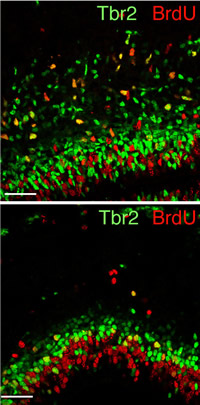
Many genes effect normal neural stem cell division and normal brain development. One gene, called Magoh, controls critical functions of RNA following splicing. In particular, it regulates protein levels of LIS1, a gene associated with microcephaly in mice and humans. If a mutation inactivates Magoh in the neural stem cell, then the production of LIS1 is disrupted, resulting in a depletion of so-called intermediate neural progenitor cells and their resulting neurons. Without the production of a normal number of neurons, the brain cannot grow to normal size.
In the study, NHGRI researchers used laboratory techniques to knock out the Magoh gene, demonstrating its role in controlling brain size. Human and mice versions of the protein coded by this gene are 100 percent identical.
In addition to its role in stem cell maintenance and division, alterations of this gene also cause chromosome defects such as the kind seen in cancer.
Microcephaly can be present at birth or may develop in the first few years of life. It is associated with Down's syndrome, chromosomal syndromes, and neurometabolic syndromes. Some children with microcephaly have normal intelligence, while others with the condition may have mental retardation, delayed motor functions, speech impairment, dwarfism and other brain or neurological abnormalities.
"These types of findings link two fields, RNA biology and stem cell biology," said Dr. Pavan. RNA molecules are fundamentally important in both gene expression and gene regulation. From DNA, RNA transfers information that is used in making the diversity of proteins made within the cells. Stem cells have the ability to differentiate into a diverse range of specialized types of cells.
The authors note that their discovery explains just one of many factors that regulate neural stem cell division but expect it to open a fruitful area of research concerning brain development and disease.
"Magoh encodes a protein that acts together with other critical proteins to regulate RNA function," said study lead author Debra Silver, Ph.D., NHGRI research fellow. "In future research we will look into the role that mutations of this gene or the genes it interacts with play the etiology of neurodevelopmental diseases."